
Dodging Goodhart
Spending time wisely

Recently, I saw someone suggesting that you should not bother cold approaching women in dating, ever, because it’s not likely to lead to marriage. To a first approximation, this is absolutely correct. The vast majority of modern marriages, for example, do not begin with two strangers in a coffee shop.
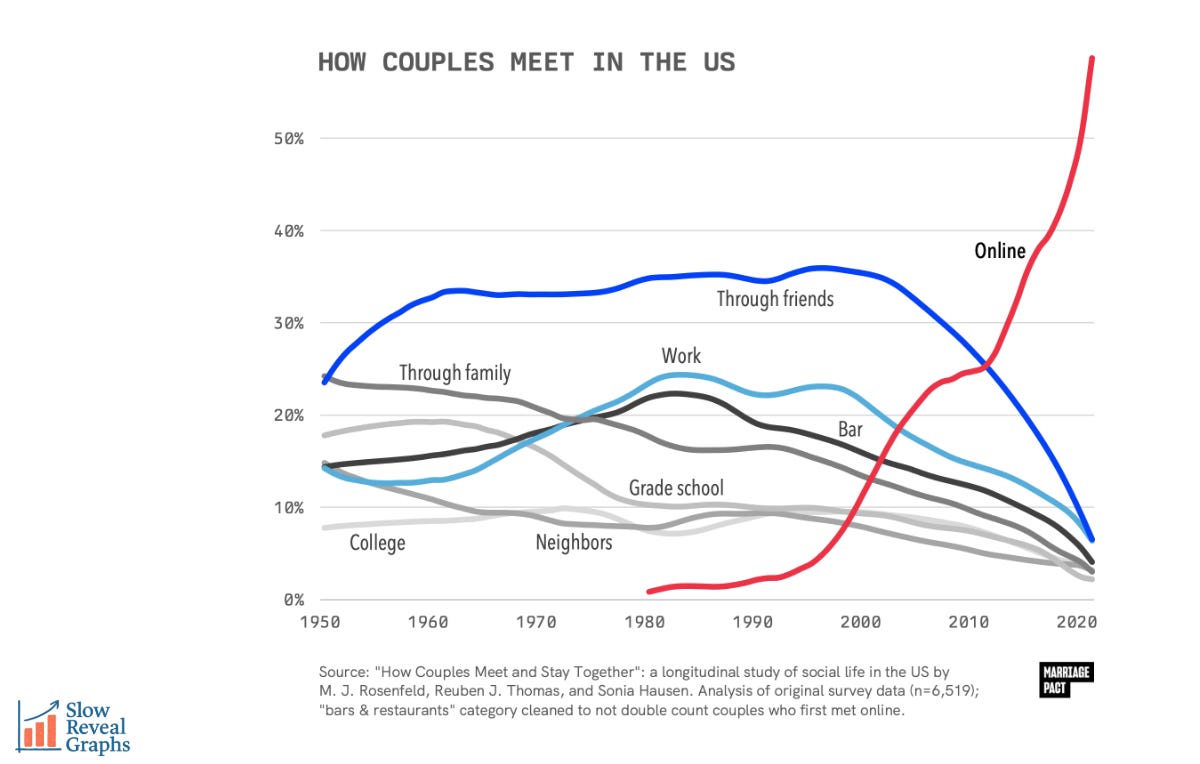
Look at that. Even meeting through friends, family, and work have dropped to below 10% of couples, with meeting in a bar the only meaningful stranger type encounter also under 10%. Absolutely dismal news for anyone looking to meet people to date on the street. It is extremely unlikely to land so much as a date chatting with a stranger, much less a relationship or a marriage. This looks like great advice to an uninitiated observer. But consider the negative space of this advice. What happens when you don’t talk to people outside?
Before you ask yourself why you’d do something if it’s not going to give you what you want, ask yourself what you’re going to do with the time you gained by not doing that thing. If it’s not better, I would be cautious about abandoning it wholesale. Beware advice that leads to actions like this in particular.
You may be familiar with Goodhart’s law: when a measure becomes a target, it ceases to be a good measure. If you’re aiming to feed a nation and you’re measuring that in bales of rice sold, you might end up optimizing for things other than avoiding starvation. Any metric you ruthlessly optimize for should be very carefully selected, because it will eclipse all other metrics. This is especially true in dating. Precious few things you do in dating are going to land you a spouse more than 10% of the time that you do them. Going out with your friends? Not likely to get you a spouse. Talking to strangers? Not likely to get you a spouse. Work? Unlikely. Using that as a metric for what should be treated as “successful” will have you staying in your house half the time.
It’s tempting to suggest that that’s the best way to get a spouse, according to the graph above. Everyone’s online! That’s where you’re going to meet your spouse! Look at the massive share of couples who met on the internet! I have my doubts about meeting online in the fashion that many couples do, but it’s absolutely true that this approach can bear fruit. Even meeting online must eventually translate into hanging out, going on dates, introducing each other to your friends and family. When that happens, you don’t want to blow your shot with your spouse by having extremely rusty social skills.
There’s no way out of intentionally spending time with real people and practicing social skills when it comes to dating. Once you have a spouse, you will still need social skills to manage work, children, and a fulfilling life. In other words, using all or even most of your social energy to find a spouse is also a potential Goodhart problem waiting to happen. All social goods, all social skills, beget better and often more plentiful relationships. You abandon their practice at cost to much more than a marriage.
Goodhart’s law is in part a story of opportunity costs: what you give up in order to chase what seems most useful. You give up a lot of potential weird upsides when you optimize carelessly. What you do tends to compound, improve, and provide you with more of what you spend time doing. If you want more people you like in your life - even just in the form of kids or a spouse or grandkids - you’ll need to spend more time with people writ large.
Social media, Tiktok (a form of TV more than social media, an idea I got from Noah Smith although I’m not sure which essay), and Netflix are gravity wells, or attractor basins, or attention magnets; choose your metaphor. They are where all human activity is drawn in the absence of something compelling to do. Now more than in the past, it’s important to be intentional about how you spend your time, because a lack of intentionality in time will often be eaten by screens. I could try to consider the possibility that time spent with screens is not all that bad. I could certainly tell you that it’s not going to permanently ruin your life, and that being able to use them some of the time is better than never using them at all. But allowing them to suck up more and more of your time is risky because your time is worth a lot more than screens generally can afford to pay you.
As I said about interpersonal judgment, modernity has conspired to make it harder to get reps in doing normal things our ancestors took for granted, including spending one’s time with other people, building things, or reading. This includes adding additional difficulty to all forms of interacting with people, all the way down to saying hi to your grocery clerk.
You should learn to and practice saying hi to and making pleasant small talk with strangers even if you don’t use this to pick up romantic partners. This will make you better at dating and socializing in a way that will better prepare you for the moment when you do meet someone you want to be with. It will give you more options and higher likelihood of good outcomes in the event that someone attractive approaches you or you see someone you really want a shot with in the wild.
The cost of spending less time with people, talking to strangers less, is affirming your belief that taking social risks is unnecessary and without value. The cost of chatting with strangers less is missing out on the potentially fortunate accidents of random meetings. Your ability to handle surprising or unusual social circumstances gets weaker, perhaps even your reliance on canned memes supplanting real time reactions gets heavier. The world contains fewer possibilities, you’re a bit less daring, and people seem a bit more foreign and scary if this approach is taken.
Be careful what you optimize for, and be careful what activities you give up because they’re not perfect. Free time increasingly falls into the screen world, and almost no one is optimizing for a life spent on the internet. That makes it harder to form all relationships. The world is about to be computer; you might have an advantage if you excel at what’s human.
Great points here. Goodhart's law Is one of my all-time favorite intellectual ideas. It’s not “theory of evolution by natural selection” great, but it’s up there :) once you start looking for it, it’s everywhere. It explains most of education of policy (where we want thing like “learning” and “workforce readiness”, but measure things like “GPA” and “ACT scores”). One of the most ridiculous examples is the Gallup employee engagement survey, where executives who want a “productive workforce” end optimizing for “survey results”.