

Have you ever thought about which of your senses emerged first in the great biological history of the world? Which of your signal options of information about the world around you has had the longest time to bake, evolutionarily speaking, and which one is the newest on the scene? It’s a question that occurred to me while writing what I intend to be tomorrow’s post, and I took a quick moment to see if my assumptions were correct.
The primordial ooze had the power to taste (and by extension the prerequisite machinery that would later allow other organisms to smell) before it could do much of anything else. Single-celled organisms - our noble, microscopic ancestors - first had the ability to pass chemical signals back and forth, with receptors that eventually developed to sense and do something different with each one.
This kind of signaling is easiest at close range, little organisms popping out small protein- or peptide-based information and handing it directly to the organism next door in a little wordless, touchless handshake. This wasn’t taste or smell directly, of course, but it’s this same set of mechanisms that taste and smell developed out of - the ability to make sense of chemical data at a molecular level when it makes contact with the cells of our tongue and the insides of our noses. So there’s a strong argument to be made that taste is the most ancient sense.
You’d think that scent would be next, but touch is the more likely followup - organisms having the ability to pellet one another with small signaling molecules made it beneficial for them to develop a sense for when they were close, eventually developing mechanosensation - the ability to detect pressure, which would later expand into other physical inputs like heat, vibrations, sharpness, softness. Touch is an ancient language, one common to most organisms, invertebrate and vertebrate alike.
Scent probably came after touch, as organisms grew complex enough to consistently need to sense tasting molecules at a distance. Of course, taste is more consistent across biological domains, or at least the chemo-sensing that makes it possible. Scent is intriguing because it requires the organisms who can do it to make sense of data spread through fluids - air or water, most commonly, and of molecules spread unevenly through turbulent flows. It’s a more complex and sensitive skillset than one might expect, benefitting from years of evolutionary pressure to become the sense as we experience it as humans.
Then, of course, sight. Photosensitivity is obvious in a great number of organisms across domains; consider the mysterious plant ability to apparently change shape, although this has not been sufficiently explained with the evidence we have. There’s even evidence suggesting that some leaf cells can focus light, with a kind of rudimentary biological lens. Darwin himself observed:
How a nerve comes to be sensitive to light, hardly concerns us more than how life itself first originated; but.....as some of the lowest organisms.....are known to be sensitive to light, it does not seem impossible that certain elements...should become aggregated and developed into nerves endowed with this special sensibility.
The above quote appears here, in a lovely review of the evolution of photo-sensitive receptors, that notes that photoreceptors similar to human rods and cones (which are load-bearing parts of human sight and not to be confused with this banger) can be found even as far back as cyanobacteria - believed to be the first organism to have produced oxygen.
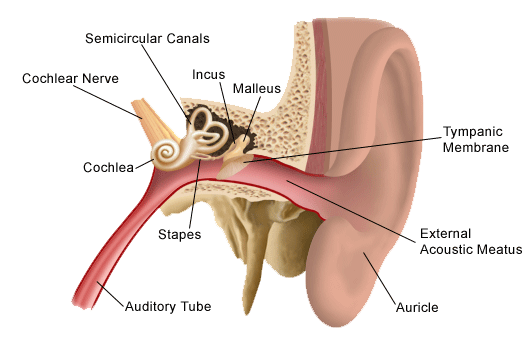
This leaves hearing last, a complex interplay of physical pressure type mechanosensing and nervous system development. Sound is a pressure wave, which you might know, but I occasionally remember with a bit of intrigue. The base thrums because there’s a small amount of pressure in every 808 bounce, tapping on the hairs in your ear canals and your eardrum (I’m sorry about the ear hair visual, but they are an important part of hearing).
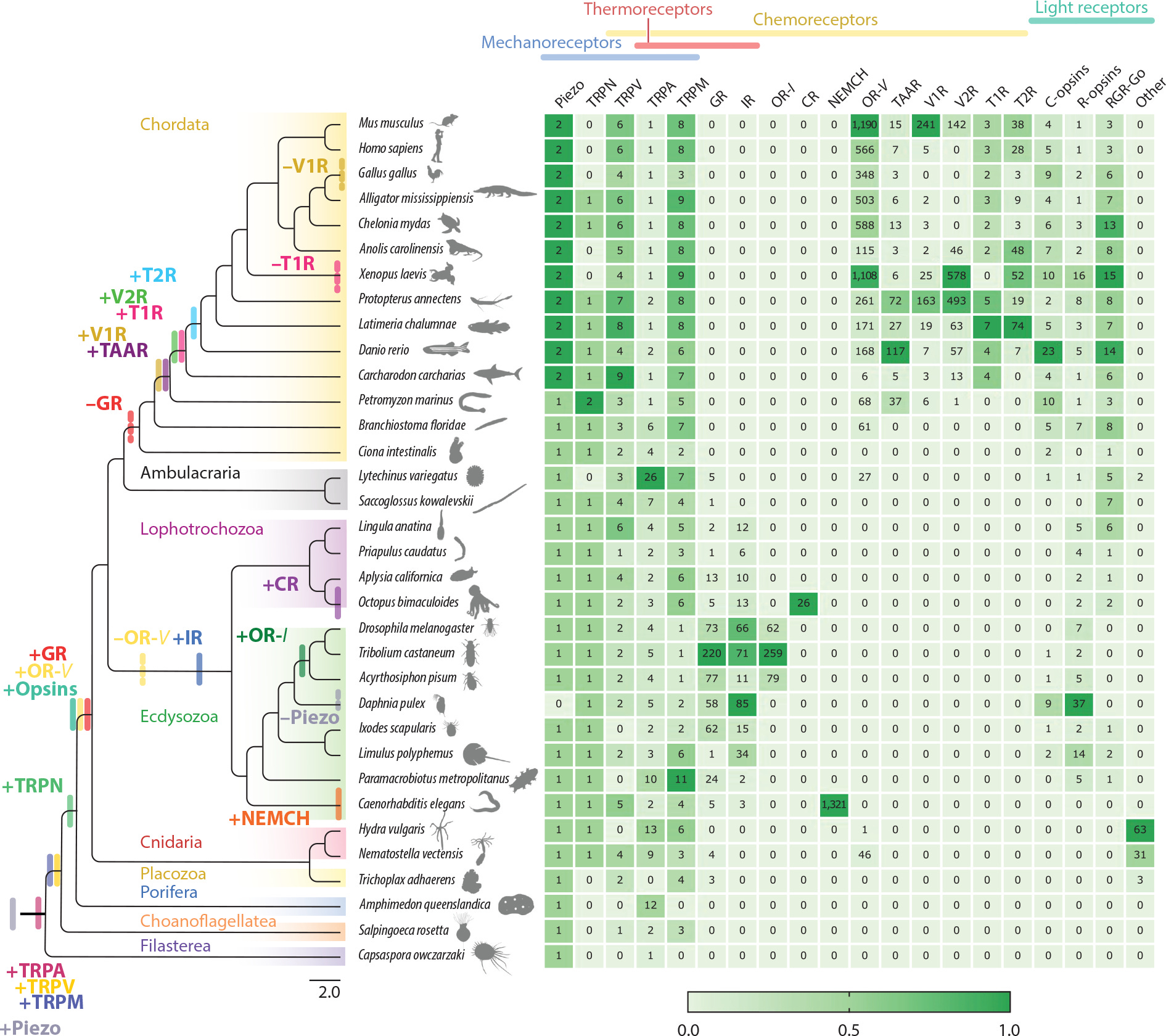
These are crazy, many of your senses predate the formation of a nervous system, much less a backbone or neocortex. Consider this impressive review from a few years ago, which includes the following figure tracking the evolution of sensory mechanisms through the history of one phylum - chordata, vertebrates like you and me.
Demands a follow-up on the evolution of our sixth sense, introspection :)
Your review has me thinking that our ability to perceive our own minds is a modification of lower senses. Of any of them, I'm partial that this relies mostly on hearing. We started to hallucinate an inner voice, and then at some point identified with it, creating an internal space we call "I." But imagine it was canines that had evolved metacognition; the self may be olfactory rather than auditory. On that world, self-domesticated dogs are writing "In the beginning was the whiff" codified in the rhinocene crede. Their self help books would be about positive self-smell.
There is also a surprising amount of personal variation. Autists often think in pictures and so seem to lean more on sight than hearing when they "look" inward. Though writing this I'm realizing that all the words we use for introspection--including introspection--are metaphors from sight, so I am very likely underrating that sense.